
Florida Homestead Exemption & Portability: A Clear Guide for Tampa Bay Homeowners
If you own a home in Tampa Bay or are thinking about buying or selling, understanding Florida’s Homestead Exemption and Homestead Portability can significantly impact your property taxes and long-term financial picture.
Unfortunately, these benefits are often misunderstood or overlooked entirely.
This guide explains:
- How Florida’s homestead exemption works
- The difference between market value and assessed value
- Florida’s 3% cap vs the 10% cap for non-homesteaded properties
- What portability is and who it benefits
- How much you can save when moving
- Filing deadlines and requirements
Whether you live in St. Petersburg, Treasure Island, St Pete Beach, Tierra Verde, Madeira Beach, Redington Beach, or anywhere across Tampa Bay, this information applies to you.

Florida Homestead Exemption Explained (and the March 1 Deadline)
Florida’s Homestead Exemption is a property tax benefit available to homeowners who use their property as their primary residence.
If approved, you may receive up to $50,000 off your home’s assessed value, which directly lowers your annual property taxes.
Important deadline: You must apply for homestead exemption by March 1st.
If you miss this deadline, you typically must wait until the following tax year to receive the benefit.
Homestead does not apply automatically. You must file with your county property appraiser.
How Homestead Works: Market Value vs Assessed Value (and the Caps)
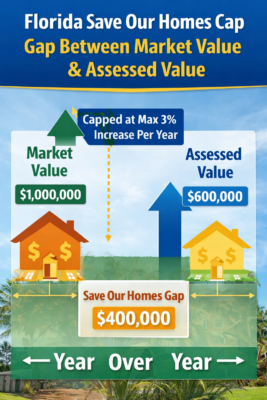
One of the most confusing aspects of Florida homestead is understanding the difference between market value and assessed value.
- Market value is what your home could sell for.
- Assessed value is what the county uses to calculate property taxes.
Once a home is homesteaded, Florida’s Save Our Homes law limits how much the assessed value can increase each year.
Homesteaded properties
Assessed value increases are capped at the lesser of 3% or the Consumer Price Index (CPI) annually.
Non-homesteaded properties
Assessed value can increase by up to 10% per year.
Over time, homesteaded homes often develop a large gap between market value and assessed value. That gap becomes extremely valuable when you move, because it may be transferred to your next home through portability.
Market Value vs Assessed Value

Requirements to Homestead a Property in Florida
To qualify for Florida homestead exemption:
- The home must be your primary residence
- You must be a Florida resident
- You may only homestead one property
- You must occupy the home as of January 1 of the tax year
- You must apply with your county property appraiser
You cannot homestead investment properties, second homes, or vacation homes.
Additional Benefit: Capital Gains Exclusion
Homesteading also connects to an important federal tax benefit when selling your primary residence.
If you sell your home after living in it for at least two of the previous five years, you may exclude:
- Up to $250,000 of capital gains if single
- Up to $500,000 if married filing jointly
This applies to profits from the sale of your primary residence and can save homeowners a substantial amount in federal taxes.
What Is Portability and Who Does It Benefit?
Homestead portability allows Florida homeowners to transfer their accumulated Save Our Homes tax savings from one primary residence to another, up to $500,000.
Portability is especially helpful for:
- Move-up buyers
- Waterfront buyers
- Downsizers
- Retirees
- Long-term homeowners with low assessed values
Without portability, many homeowners would experience a major increase in property taxes after moving.
Real-Life Example
Let’s walk through a simplified scenario.
You purchased a home years ago for $500,000. Over time, the market value rises to $800,000, but due to the Save Our Homes cap, your assessed value is only $500,000.
That creates a $300,000 gap.
You sell and purchase a new home for $1,000,000. Through portability, that $300,000 difference transfers to your new property. Instead of being taxed on $1,000,000, your new assessed value may be closer to $700,000.
That reduction can save thousands per year in property taxes. Over time, those savings add up significantly.


How Long You Have to Port Your Benefit (and How to Do It)
You must establish homestead on your new primary residence within three tax years of selling your previous homesteaded home.
To port your benefit:
- Apply for homestead exemption on your new property
- File a portability application at the same time
- Complete both by March 1
You’ll typically need:
- Previous homestead address
- Ownership dates
- Florida driver’s license
- Proof of residency
Portability does not happen automatically.
Other Important Details Homeowners Often Miss
- Portability only applies within Florida
- It only applies to primary residences
- You may use portability multiple times if eligible
- Portability affects property taxes, not mortgage payments
- Buying without understanding tax implications can significantly change affordability
This is especially important for waterfront and higher-priced homes.
Have Questions? Let’s Talk.
Homestead exemption and portability are not just administrative steps. They directly impact purchasing power, monthly expenses, and long-term planning.
I help Tampa Bay homeowners:
- Estimate portability savings
- Compare tax scenarios
- Avoid filing mistakes
- Strategically plan moves and upgrades
If you’re thinking about selling, buying, or upgrading, or simply want clarity on how homestead and portability apply to your situation, reach out anytime. I’m happy to walk you through your options and help you make informed decisions before the March 1 deadline.