
Fall is when Tampa Bay comes back outside. The humidity begins to ease, and weekends fill with seafood festivals, outdoor concerts, pumpkin patches, farmers markets, and Little League games. Grandparents, parents, and kids all find a reason to gather.
Along the Pinellas beaches—from Clearwater Beach and Sand Key to Indian Rocks Beach, Madeira Beach, Treasure Island, and St. Pete Beach—those days often end with a sunset the whole family enjoys together. For many families, moments like these happen only a few times a year, usually around the holidays. Others are choosing to live closer so they can make these memories year-round.
Whether that means sharing a home, moving onto the same street, or finding a condo a few floors away, being close to family offers something valuable: more opportunities to share everyday life.
A Trend Decades in the Making
Multigenerational living isn’t a passing fad. According to Pew Research Center, the share of Americans living in multigenerational households more than doubled over five decades, growing from 7% in 1971 to 18% in 2021. That represents nearly 60 million people living with two or more adult generations, or grandparents living with grandchildren.[1]
Living nearby in separate homes isn’t counted in those household statistics, but it reflects a similar desire for connection and support.
Tampa Bay’s housing inventory offers options for families considering a shared home. Realtor.com’s analysis of 2025 listing data found that 9.0% of listings in the Tampa-St. Petersburg-Clearwater metro area included features associated with multigenerational living, compared with 6.1% nationally. These properties were identified through listing terms such as “in-law suite,” “guest house,” and “ADU.”[2]
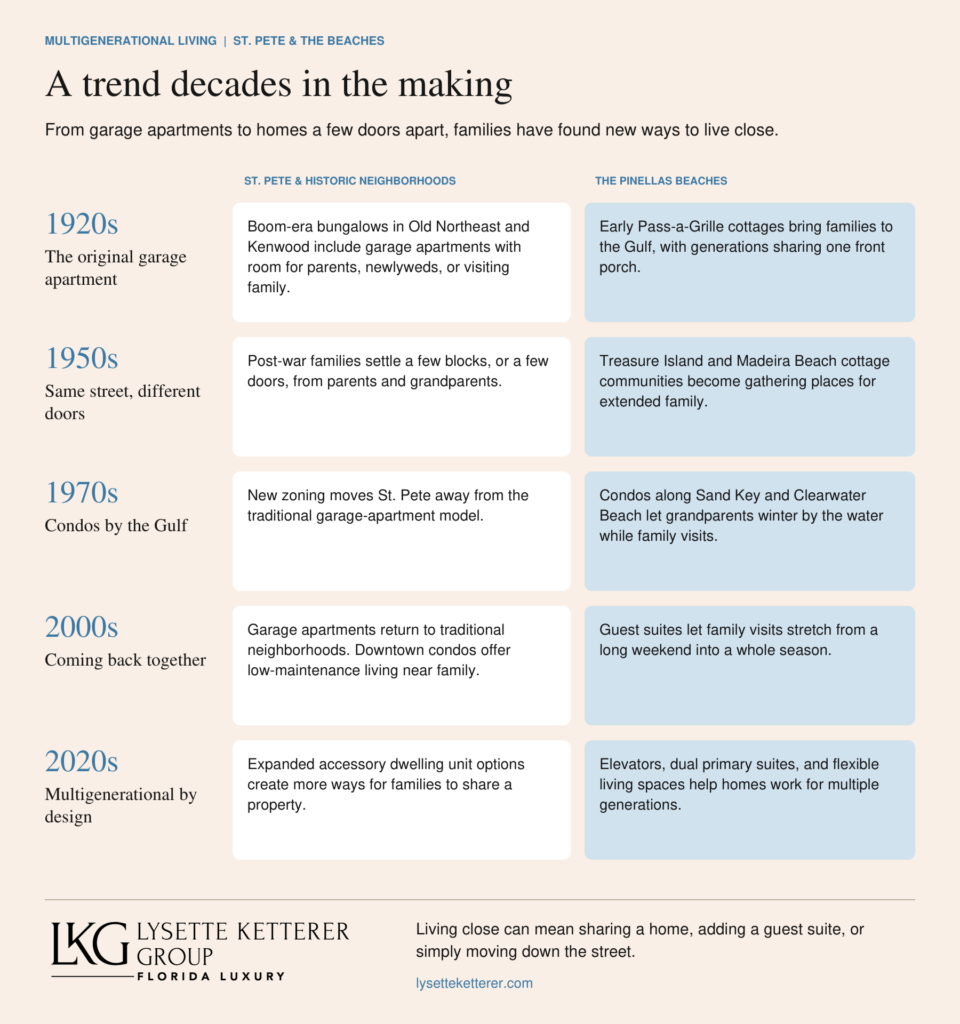
From garage apartments to nearby homes, living close to family has taken many forms over the decades.
What Home Buyers Are Doing
According to the National Association of REALTORS®’ 2026 Generational Trends report, 14% of buyers purchased a multigenerational home. While that was down from 17% in the previous report, it remains a meaningful part of the market.[3]
Generation X—the “sandwich generation,” often balancing aging parents’ needs with support for their children—had the highest share, with 19% purchasing multigenerational homes.[3] For these families, flexible space and privacy can be just as important as having enough bedrooms.
The Heart of It: Why Families Choose to Be Close
The numbers show what’s happening. The reasons show why it matters.
Caring for the people who cared for us. In NAR’s 2025 Profile of Home Buyers and Sellers, 41% of multigenerational buyers cited caring for aging parents as a reason for their purchase.[4]
Simply wanting more time. Another 23% cited spending more time with aging parents.[4] Sometimes the goal is more Sunday dinners, more shared celebrations, and more ordinary Tuesdays together.
Grandparents as everyday presences. When grandparents live nearby, they can be part of the weekly rhythm: cheering at soccer games, helping with pickups, and sharing stories children will remember for years.
Why It Matters to Us
At the Lysette Ketterer Group, living close to family is more than a housing trend. It’s how we live.

Two doors down, countless memories together. Having grandparents nearby makes everyday moments a little more special.
Lysette grew up in Tampa and is raising her three active boys in Treasure Island with her husband, Mark. When her parents moved two doors down, it changed everyday life: extra hands for pickups and practices, family dinners, and more time together, especially between the kids and grandparents. Everyone has their own home, but family is just a short walk away. They are currently in the process of looking for home down here for Mark’s parents too!
Lisa lives a ten-minute walk from her in-laws in Tierra Verde. Her mother-in-law, a nurse from Connecticut, met her match while visiting the island. Today, their families share a blended life with a wide circle of friends of all ages. On island time, everyone enjoys the same things: sunshine, a good sunset, ring toss on Thursdays at Billy’s, and a cold drink.
We’ve helped families find homes that bring generations closer, whether under one roof, on the same street, or a short drive away. We listen closely and explore options that give everyone room to feel at home.
The Practical Side
Being close to family can also make everyday life more affordable. In Pew Research Center’s 2022 report, 57% of adults ages 25–39 who lived with a parent cited financial issues as a major reason.[5] Sharing housing expenses can give younger adults breathing room to save and work toward a home of their own.
For families with young children, childcare is another major expense. Child Care Aware of America reported that Florida’s average annual cost of full-time, center-based care in 2024 was $13,011 for an infant and $9,409 for a four-year-old. Together, that’s more than $22,000 a year—about $1,870 a month.[6]
When grandparents are willing and able to help, living nearby can ease some childcare expenses and make school pickups, work schedules, and unexpected gaps in care more manageable. Whether sharing a roof or living two doors down, family proximity can offer both meaningful connection and practical support.
What Living Close Can Look Like on the Gulf Coast
There’s no single right answer. Families here may consider:
- One home with room for everyone: An in-law suite, guest house, or thoughtfully separated living areas that balance togetherness with privacy. Many homes in St Pete with access to an alleyway allow an in-law suite to be built over the garage.
- Two homes, one neighborhood: Separate homes a short walk or drive apart, so everyone keeps their own space.
- Condos in the same building: Separate residences with shared access to amenities and nearby dining.
- Homes built for gathering: Open kitchens, covered lanais, and outdoor spaces where everyone can comfortably spend time together.
The best arrangement depends on your family’s budget, routines, and expectations—not just the floor plan.
Closer Together, Starting Now
Fall gatherings can be a natural time to start the conversation. Before looking at homes, consider:
- How much day-to-day help do we want, and how much independence?
- What expenses and responsibilities would we share?
- If grandparents will help with childcare, what schedule feels comfortable for everyone?
- Will our needs change in five years as children grow or parents age?
- Could our current home accommodate those needs, or should we explore other options?
- Are schools, parks, and healthcare convenient for everyone?
- If we’re considering an ADU or guest suite, what do local zoning and permitting rules allow?
Choosing the right arrangement means looking beyond square footage. Privacy, accessibility, location, and clear expectations all help create a home—or a pair of homes—that works for the whole family.
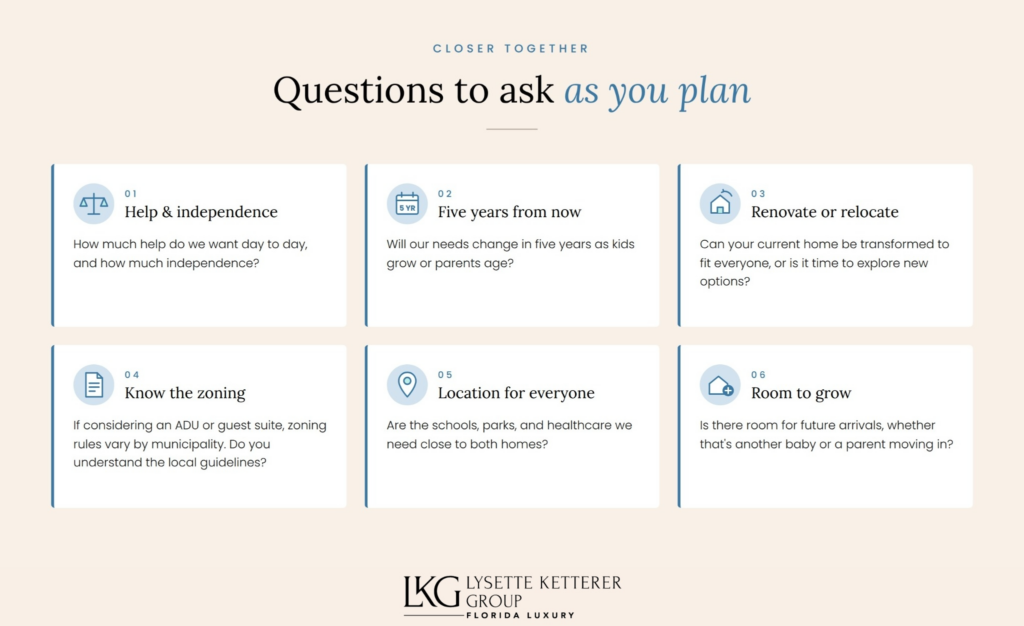
Finding the right arrangement starts with conversations about what each generation needs.
At the Lysette Ketterer Group, we’ll help you explore the possibilities across Tampa Bay and the Gulf Beaches, from homes with separate living spaces to nearby properties that keep loved ones within easy reach.
Thinking about bringing your family closer? Reach out to discuss what that could look like for you.
Sources
- Pew Research Center, March 24, 2022: The Demographics of Multigenerational Households. Population figures reflect 2021 data and Pew’s definition of multigenerational households. Read the research. www.pewresearch.org
- Realtor.com, May 5, 2026: Under the Same Roof: Multigenerational Living in the U.S. Listing figures reflect 2025 inventory classified through property-description keywords; they do not measure how many families actually share those homes. Read the report. www.realtor.com
- National Association of REALTORS®, 2026: Baby Boomers Remain Largest Share of Home Buyers as First-Time Buying Falls to Record Low. Reports 14% of all buyers and 19% of Gen X buyers purchasing multigenerational homes. Read the findings. www.nar.realtor
- National Association of REALTORS®, 2025: Making Extra Room at the Table: Multi-Generational Homes in the United States. Summarizes purchase motivations from the 2025 Profile of Home Buyers and Sellers. Read the analysis. www.nar.realtor
- Pew Research Center, March 24, 2022: The Experiences of Adults in Multigenerational Households. Financial-motivation findings come from a survey conducted in October 2021. Read the research. www.pewresearch.org
- Child Care Aware of America: 2024 Child Care Affordability Analysis, Table I. Prices are Florida statewide averages for full-time, center-based care; actual Tampa Bay costs vary by provider. Monthly totals were calculated from the annual figures. View the report. info.childcareaware.org